The Best Luxury Glamping Spots USA: A Strategic Guide to Outdoor Hospitality
The rise of the “glamorous camping” movement, more commonly known as glamping, represents a profound shift in the American hospitality landscape. What began as a niche, counter-cultural alternative to the stark simplicity of traditional tent camping has matured into a sophisticated sector of the travel industry. Today, it occupies a distinct space between the rugged outdoors and the full-service resort, offering a curated experience that prioritizes the visceral connection to nature without the attrition of modern comfort. For the traveler, this evolution has democratized access to remote, high-aesthetic environments that were once the exclusive domain of extreme outdoorsmen.
However, this rapid institutionalization of the sector has created a challenging information environment. The term has become a catch-all marketing label, applied with equal frequency to a basic canvas tent on a wooden deck and a climate-controlled, multi-room architectural masterpiece. Discerning the difference requires an analytical approach that treats the destination as a complex logistical system rather than a collection of photogenic features. Understanding this sector demands a move away from the allure of curated social media aesthetics and toward a structural evaluation of the property’s site-management, environmental integrity, and service architecture.
Understanding “luxury glamping spots USA.”
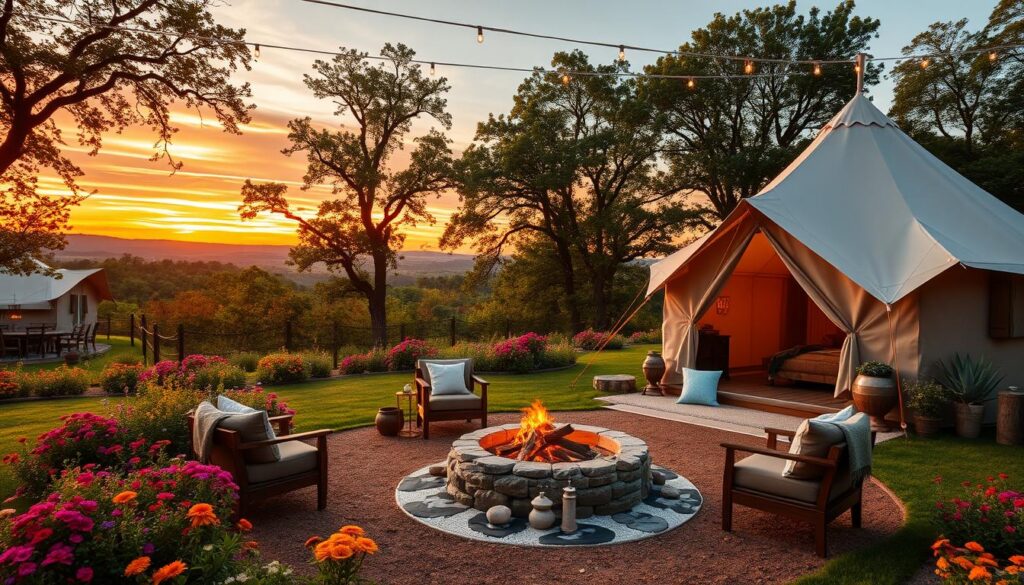
The search for luxury glamping spots in the USA is often obstructed by the ambiguity of the industry’s defining terminology. Because there is no standardized regulatory definition of “glamping,” a property owner may legally market anything from a rustic yurt to a high-density cabin resort under the same umbrella. This creates a significant risk for the high-end traveler: the misalignment of expectation and delivery. True luxury in an outdoor setting is defined by the quality of the isolation, the seamless integration of climate-control infrastructure, and the professional-grade service architecture.
A common misunderstanding is the conflation of “uniqueness” with “luxury.” While a treehouse or a geodesic dome may provide a unique aesthetic, the luxury experience is dictated by the unseen systems, the reliability of water and waste management, the presence of localized power stability, and the sophistication of the site’s topography and privacy management. The luxury glamping spots USA category, when viewed through a lens of professional hospitality, is defined not by the novelty of the ten, but by the ability of the operator to insulate the guest from the inherent discomforts of nature without severing their connection to the environment.
Deep Contextual Background: The Evolution of Institutional Glamping
The trajectory of the sector has moved from early ad-hoc DIY sites to the current era of “institutional glamping.” With major hospitality capital now flowing into the sector, we are seeing the emergence of standardized luxury models that utilize modular architecture to overcome the regulatory and logistical hurdles of remote development. This shift has enabled a predictable “premium” experience while simultaneously raising the barrier to entry for smaller, boutique operators.
Conceptual Frameworks and Mental Models
-
The Isolation-Infrastructure Paradox: A property’s luxury score is a function of its remote location vs. its internal service reliability. The highest-quality sites succeed by providing absolute seclusion while masking the extensive infrastructure required to support it.
-
The Site-Density Index: A critical evaluation tool. Luxury is inversely proportional to unit density. A high-value resort prioritizes the visual and acoustic privacy of the guest over the total unit count.
-
The Lifecycle Resilience Model: Evaluating how a structure performs across the four seasons. A “luxury” unit must be as capable in a mid-winter storm as it is during a summer afternoon.
-
The Experience-Architecture Alignment: The “hero feature” of the unit (e.g., a glass ceiling or a cliffside deck) should be the primary driver of the structural layout, not an afterthought of the design.
Categorizing Operational and Experiential Models
| Category | Typical Structure | Primary Luxury Metric |
| Architectural Retreat | Treehouse / Modular Cabin | Design-led / Permanent |
| Expeditionary Safari | High-end Canvas / Safari Tent | Service-led / Mobile-modular |
| Geodesic/Dome Horizon | Geodesic Dome | View-led / Panoramic |
| Heritage/Nostalgia | Vintage Airstreams | Brand-led / Curated |
Choosing the “right” category requires an assessment of your personal threshold for “nature-exposure.” The Safari tent offers a visceral, sound-permeable experience, while modular cabins offer a more sound-buffered, “hotel-like” security.
Detailed Real-World Operational Scenarios
-
The “Utility-Spine” Reliability Failure: In remote sites, infrastructure is the first point of failure. A resort that lacks a secondary power source or redundant water storage risks a total system collapse during minor weather events.
-
The Privacy-Density Conflict: Sites that over-optimize for volume often place units in sightlines of one another. The failure mode here is a loss of the “seclusion” promised in the booking premium.
-
The Topographical Mismatch: A site built on a steep gradient without proper path architecture leads to difficult transit, especially for those with accessibility needs. An evaluation of “arrival logistics” is essential for any high-end site.
Planning, Cost, and Resource Dynamics
| Resource Type | Sustainability/Reliability Impact | Financial Complexity |
| Permitting/Zoning | High (Regulatory Risk) | Very High |
| Off-Grid Engineering | High (Operational Reliability) | High |
| Staffing/Concierge | Medium (Experience Quality) | Moderate |
The cost of staying at the top-tier luxury glamping spots usa destinations is largely a pass-through of these substantial development and operational costs. Guests should expect premium pricing as a reflection of the “hard-engineered” comfort provided in wilderness zones.
Tactical Strategies and Support Systems
-
Site Mapping Analysis: Before booking, look at the resort’s site map. Note the distance between units and the location of shared amenities (fire pits, restaurants). If the units are clustered, your privacy will be compromised.
-
Weather-Resilience Audit: Check if the property offers climate-controlled units. In the American landscape, seasonal extremes (wind, heat, cold) are the primary killers of a luxury experience.
-
The “Arrival Logistics” Test: Does the resort have a paved access road and dedicated guest transport, or are you expected to arrive via an unmaintained trail? High-end operations almost always provide seamless, managed arrival.
-
Vendor-Direct Inquiries: For truly elite properties, a quick call to the concierge about specific infrastructure (e.g., “Is the hot water on-demand or tanked?”) will immediately clarify the level of operational sophistication.
The Risk Landscape: Failure Modes
-
The Seasonal Collapse: Many sites operate as seasonal shells. A resort that hasn’t invested in robust insulation and high-performance climate systems will be functionally unusable in shoulder seasons.
-
The Permitting Fragility: Some sites operate in regulatory grey zones. A risk exists that a location could be shuttered mid-season due to zoning non-compliance, a recurring issue in rapidly developing areas.
-
The Wildlife-Human Interface: Inadequate waste management systems lead to animal intrusions. A luxury site must have high-grade, impenetrable waste infrastructure to maintain a secure environment.
Governance, Maintenance, and Long-Term Adaptation
-
The Maintenance Cadence: High-end sites require constant upkeep of canvas, decking, and utility lines. Look for sites that disclose their off-season renovation or inspection cycles.
-
Adaptive Management: A sophisticated operator will adjust site density based on land-impact data. Sites that “rest” certain areas of their property show a higher level of environmental and structural stewardship.
-
Layered Checklist: For future bookings, verify: 1. Zoning legitimacy. 2. Climate-control ratings. 3. Privacy-density statistics. 4. Utility-backups.
Measurement, Tracking, and Evaluation
-
Leading Indicator: The quality of the digital booking experience. An operator who invests in a high-fidelity website and transparent unit mapping usually invests in the operational side of the property.
-
Qualitative Signal: Review focus: Ignore the “Instagram” comments; look for reviews mentioning infrastructure reliability (heat, water pressure, internet).
-
Quantitative Signal: The “Service-to-Guest” ratio. Premium sites usually maintain a dedicated staff presence even at night.
-
Documentation Example: The “Infrastructure Continuity Log.” A simple mental note or inquiry about emergency protocols (e.g., generator backup) during the booking process.
Deconstructing Misconceptions
-
“Glamping is eco-friendly”: Not necessarily. Many sites have a high carbon footprint due to the need for localized climate control and remote logistics.
-
“It’s just a tent”: At the luxury level, these are high-performance engineering feats, not recreational equipment.
-
“The view is the only amenity that matters”: Without interior climate stability and privacy management, even the best view becomes a source of frustration.
-
“Any remote location is a luxury site”: Luxury requires service, reliability, and security. A remote tent is just an expedition; a luxury glamping site is an optimized, curated resort.
Ethical and Contextual Considerations
The expansion of these resorts into sensitive wilderness areas necessitates a conversation about land impact. Ethical travelers should favor operators who employ “low-impact” foundation strategies (such as raised platforms that avoid ground excavation) and who participate in local habitat-restoration initiatives. Your patronage of these sites is a signal to the industry regarding the standards of ecological and structural performance you expect.
Conclusion
The pursuit of the luxury glamping spots USA category is an exercise in discerning the intersection of engineering and environment. It requires the traveler to set aside the generic appeal of “outdoorsy” marketing and engage with the property as a specialized resort. By prioritizing operators who demonstrate a mastery of site infrastructure, privacy architecture, and service-level reliability, one can ensure that the experience is one of immersion rather than intrusion. In the final analysis, the most successful of these destinations are those that offer a sophisticated, managed, and profoundly private dialogue with the natural world.